
Compare three
Broshuis trailers
Each with approximately 20 tons payload within a 40-ton gross weight
Ask us
your question!
Comparing special trailers
There is a wide range of standard semi trailers available, each suited to a specific application. But sometimes a load requires just a little more. For example, when it exceeds standard European dimensions. Which semi trailer is the best fit for your operation?
At Broshuis, we are happy to think along with you. That it why we compare three types of semi trailers within the 'light' special segment. As a reference, we assume a 6x2/4 truck with a tare weight of 9 tonnes and a permitted gross vehicle weight of 27 tonnes, resulting in a kingpin load of 18 tonnes.
All three semi trailers are extendable and equipped with an 18t neck, allowing the available kingpin load to be used fully and safely. They differ in payload capacity and loading floor height, with each trailer having its own strengths and features that make it better suited for specific types of transport. Below, we clearly outline these differences to help you make a well-informed decision.
Load capacity
All trailers offer a load capacity of over 20 t in combinations with a 9 t 6x2/4 truck, within a 40 t gross combination weight. The flat trailer achieves the highest payload. Thanks to its higher and stronger main beams, less steel is required compared to a semi low loader, resulting in a higher load capacity.
Specifically, this means that the flat trailer has a load capacity of 22.3 t. The 4-axle self-tracking semi low loader reaches 21.1 t, while the 3-axle steered semi low loader comes in at 20.1 t.
In this comparison, the 4-axle self-tracking semi low loader is equipped with smaller 205 tyres. This results in a lower loading platform height, with a slightly reduced permitted axle load as a trade-off.
| 3-axle steered semi low loader | 4- axle semi low loader (205) | 3-axle platform trailer | |
|---|---|---|---|
| Tare weight (without options) | 10.9 t | 9.9 t | 8.7 t |
| Load capacity EU (9 ton tractor) |
20.1 t | 21.1 t | 22.3 t |
| Floor height (loaded) | 895 mm | 780 mm | 1,380 mm (1,160 mm coupling height) |
| Loading height (4 m overall height) |
3,105 mm | 3,220 mm | 2,620 mm |
| Maximum axle load within EU law |
8 t | 8.24 t | 9 t |
| Possibel axle load with EU excemption |
10 t | 8.28 t (due to 205 tyres) | 9 t (axle limiting) |
Loading platform height
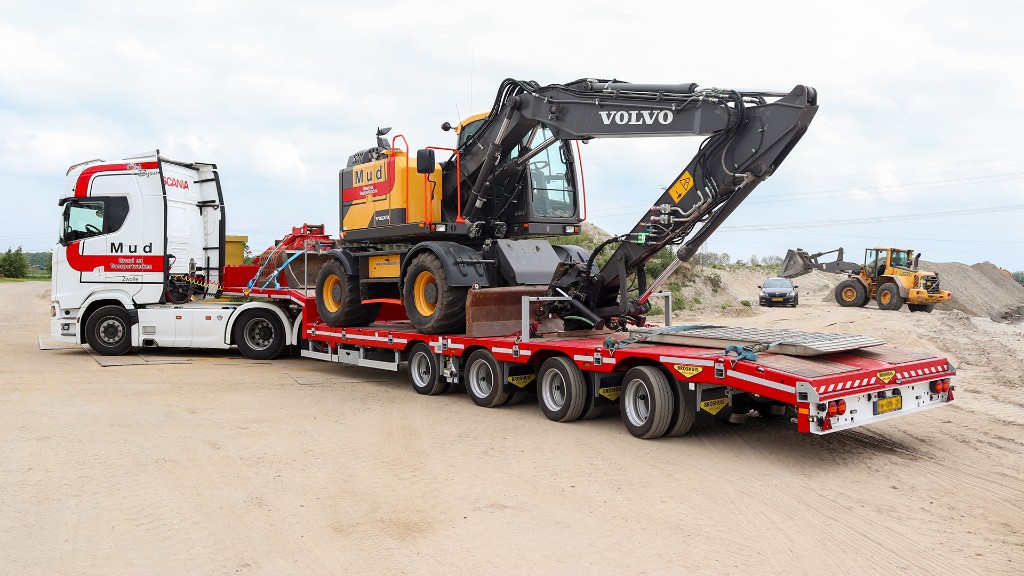
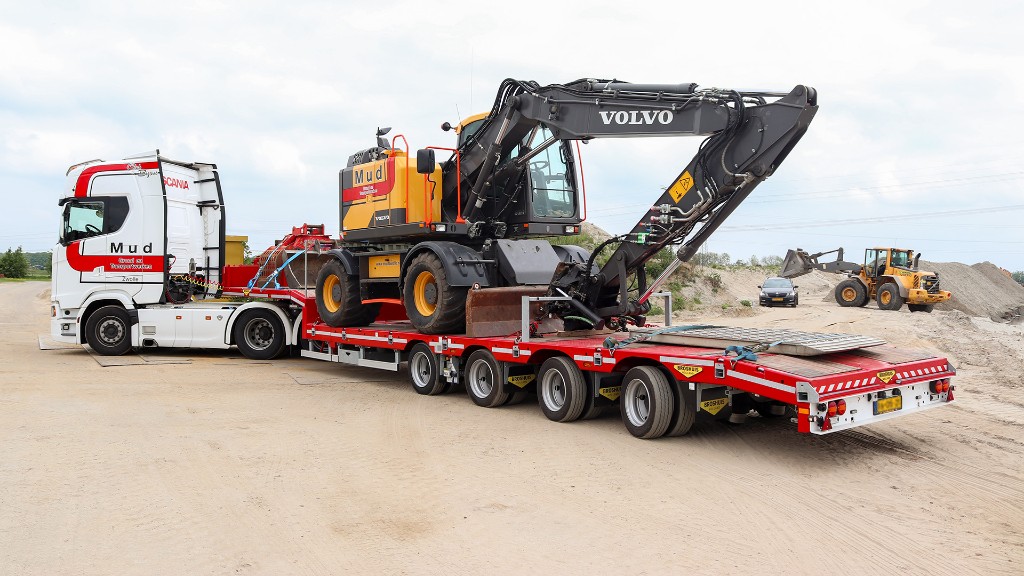
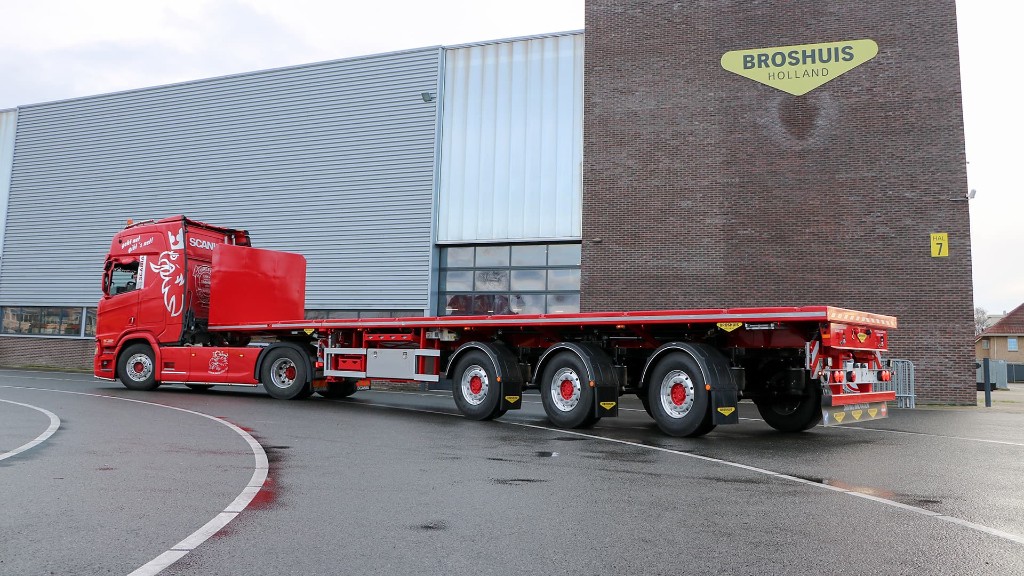
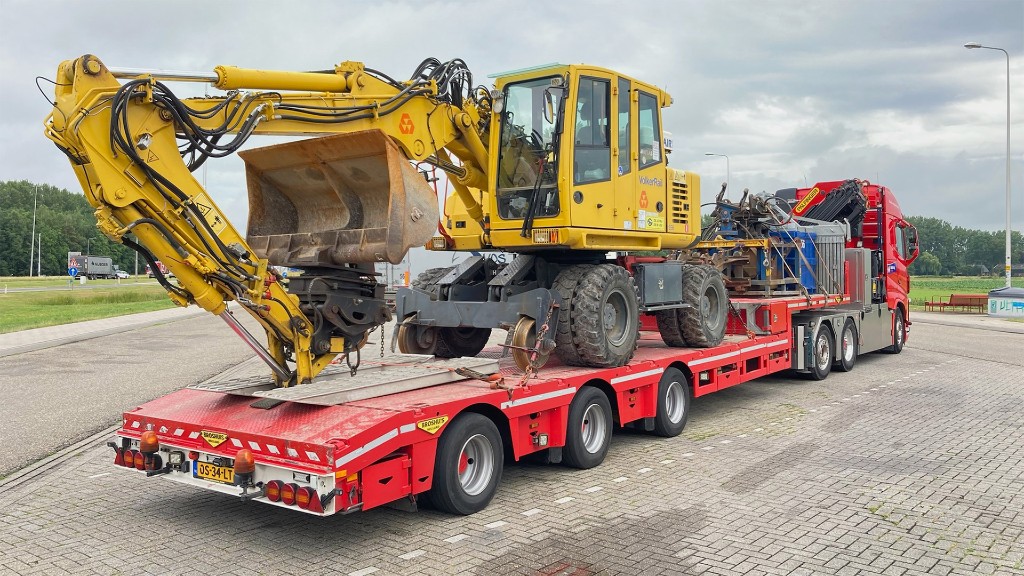
The loading deck height of a semi low loader is significantly lower than that of a flat trailer. The flat trailer has a loading deck height of 1,380 mm, allowing loads up to 2,620 mm high to be transported within the 4 metre height limit. The 3-axle steered semi low loader has a loading platform height of 895 mm, providing a loading height of 3,105 mm. The 4-axle self-tracking semi low loader with 205 tyres goes one step further, with a loading platform height of just 780 mm, enabling an impressive loading height of 3,220 mm.
Loading Platform
The flat trailer has a uniform loading platform height from front to rear. This makes it extremely suitable for transporting long loads. Containers can also be transported easily on a flat trailer; in many cases, twistlocks are already integrated into the trailer. A flat trailer is less suitable for heavy, compact loads, for which a semi low loader is a better solution.
A semi low loader is a versatile transport solution, suitable for both loading and transporting machines as well as carrying long loads. Thanks to its sloped rear, it is also suitable for machines to drive onto the trailer independently. When transporting long loads, a load support is required to bring the load tot he same height as the neck. The loading platform of a semi low loader is designed to be stronger, as wheeled vehicles create point loads on the trailer floor.
Steering
The 3-axle semi low loader and the flat trailer are both hydraulically steered. This makes them more manoeuvrable when extended and during reversing. When extended, the steered trailer is just as manoeuvrable as a standard 13.6 metre tailer. The steering system significantly simplifies operation in challenging locations, especially with the use of radio remote-controlled steering assistance.
The 4-axle semi low loader is equipped with self-tracking axles. When reversing, the axles are locked, causing the trailer to reverse with rigid axles, which makes manoeuvring more difficult. Optional steering assistance is available, allowing the axles to be controlled via a radio remote control. The self-tracking semi low loader is ideally suited for long distances and operations involving mainly forward driving.
Conclusion
There is always a trailer that perfectly fits your transport challenge, with the right features and benefits for your operations. Each type of trailer has its own characteristics and advantages. Broshuis offers all these configurations and can realise any desired setup. With the expertise of our advisors, we help you choose the trailer that best matches your operations.